We started carrying out research about babies outdoors in 2019 because we realised that there’s been very little research published about babies and toddlers outdoors both in the UK and internationally. We’ve been funded by The Froebel Trust to complete two research projects, firstly A life ‘in and with nature?’ An exploration of outdoor provision in baby rooms and most recently A Froebelian inspired nature pedagogy in urban babyrooms. Here are some of our research reports, journal articles, webinars and blog posts.
Research reports
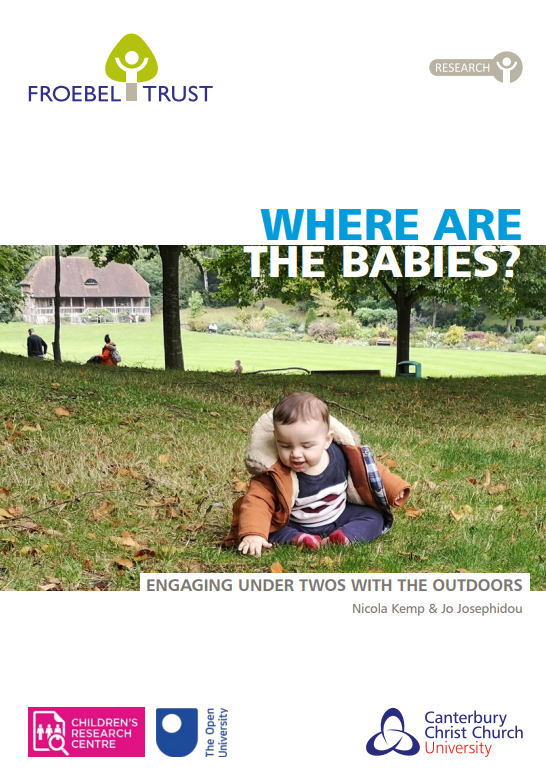
Where are the babies?
We began by looking at what research in the UK and internationally had taken place about babies and toddlers outdoors. We found that there has been little research published about outdoor provision for under 2s, and so little is known about the access the youngest children have to outdoor environments or what their experiences are like. We learnt that there seems to be two reasons why people don’t think that babies and toddlers belong outdoors. The first is because of health and safety concerns that the outdoors is a risky space for them. The second is because of a belief that the outdoors is a space to be physically active, with an assumption the outdoor environment is only appropriate for those children who can already walk.
Kemp, N. and Josephidou, J. (2020) Where are the babies? Engaging under twos with the outdoors. Available at: https://www.froebel.org.uk/uploads/documents/Report-1-Where-are-the-babies.pdf.
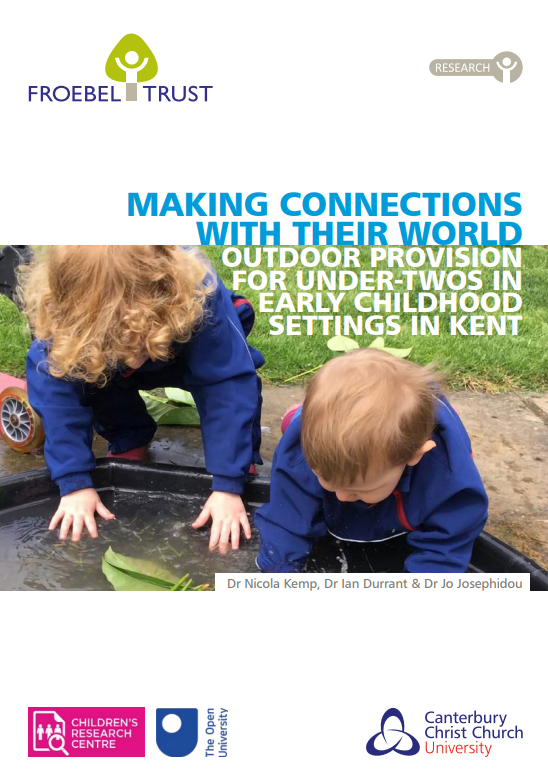
Making connections with their world
We then followed our literature review with an audit of babyroom outdoor provision across ECEC settings in Kent, England. We found that whilst there is consensus that spending time outdoors is important for both babies and toddlers, there is considerable variation in the level of resources they use to facilitate this and the priority it is given in practice. Some settings have very little space and few resources whilst others offer access to extensive and varied outdoor environments either directly linked to their sites or within their local community. Other factors such as the support of staff and parents also influence practice.
Kemp, N., Durrant, I. and Josephidou, J. (2020) Making connections with their world: outdoor provision for under-twos in early childhood settings in Kent. Available at: https://www.froebel.org.uk/uploads/documents/Froebel-Trust-Research-Making-Connections-With-Their-World.pdf.
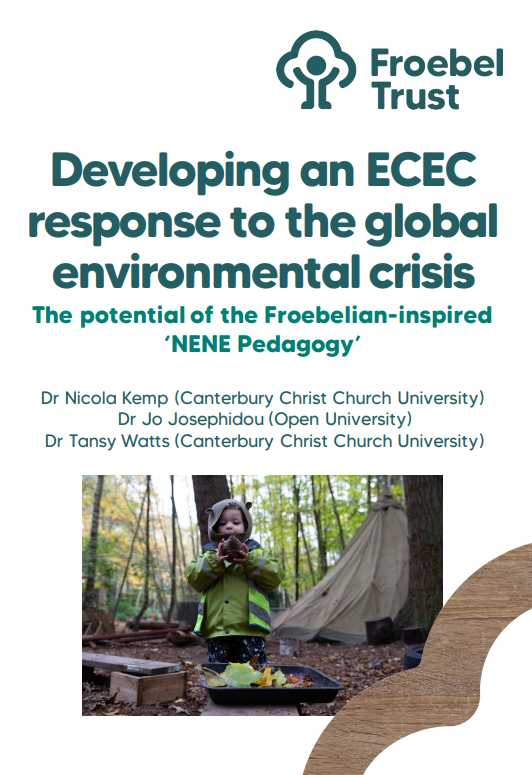
Developing an ECEC response to the global environmental crisis
Our first research project led us to develop the tentative concept of a NENE (nature engaging and nature enhancing) pedagogy. We then wrote a report that outlines the pedagogy in more detail, considers how it is specifically Froebelian and suggests some practical ways that early childhood practitioners can adopt a Froebelian-inspired NENE pedagogy.
Kemp, N., Josephidou, J. and Watts, T. (2022) Developing an ECEC response to the global environmental crisis: The potential of the Froebelian-inspired ‘NENE Pedagogy’. Available at: https://www.froebel.org.uk/uploads/documents/FT-NENE-Pedagogy-report-Dec-2022.pdf.
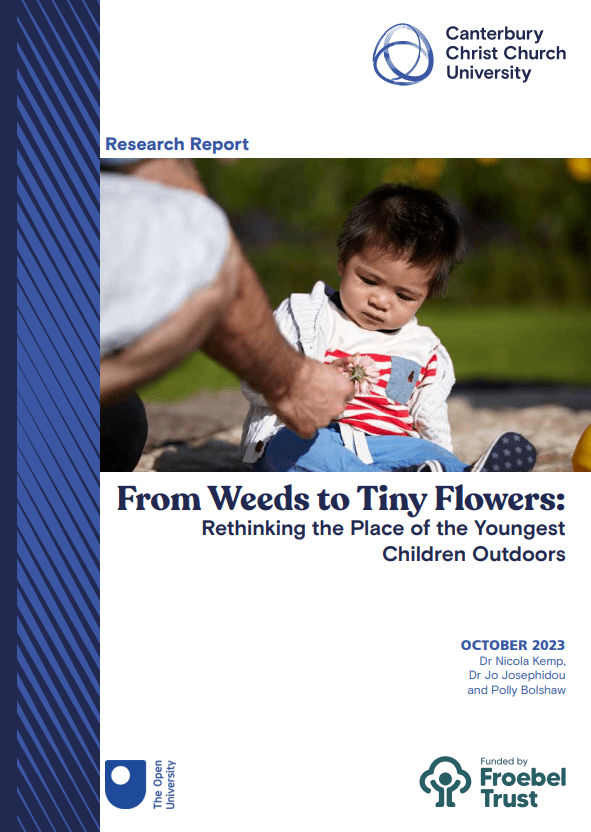
From weeds to tiny flowers
In 2023 we completed a systematic search of the international research literature to find any research about babies and toddlers outdoors. We found that a range of intersecting social characteristics (socio-economic status, education, class, ethnicity, and disability), cultural, and environmental factors are understood to influence interactions outdoors. ECEC settings have a potentially critical role in developing more inclusive practices, and challenging the idea that the youngest children don’t belong outdoors.
Kemp, N., Josephidou, J. and Bolshaw, P. (2023) From weeds to tiny flowers: rethinking the place of the youngest children outdoors. Available at: https://www.froebel.org.uk/uploads/documents/FT-From-Weeds-to-Tiny-Flowers-Miday-way-report-Nov-23-Kemp-Josephidou.pdf.
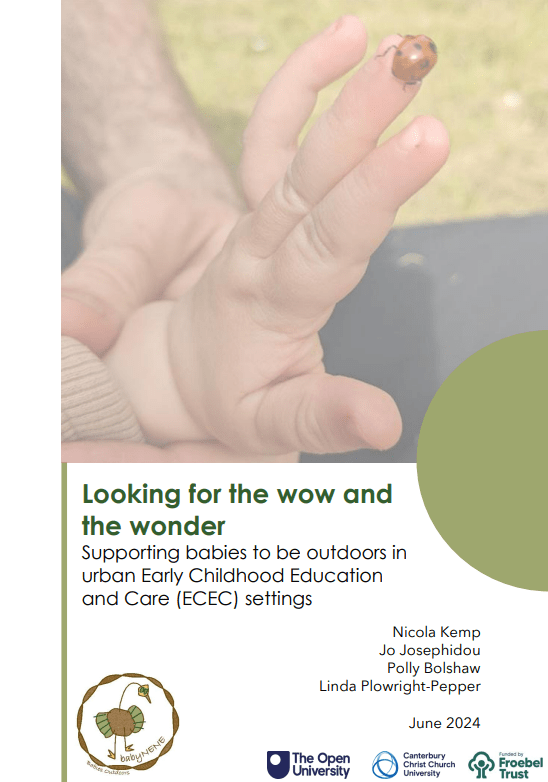
Looking for the wow and the wonder: supporting babies to be outdoors in urban Early Childhood Education and Care (ECEC) setttings
In 2024 we undertook five initial research visits to five urban babyrooms in London because we wanted to understand the specific challenges and opportunities for providing inclusive nature-based pedagogies for babies and toddlers in urban areas before collaboratively designing an intervention.
Kemp, N., Josephidou, J., Bolshaw, P. and Plowright-Pepper, L. (2024) Looking for the wow and the wonder: supporting babies to be outdoors in urban Early Childhood Education and Care (ECEC) settings. Available at: https://files.froebel.org.uk/production/documents/FT-Looking-for-the-Wow-and-the-Wonder-Report-June-2024-Kemp-Joesphidou.pdf.
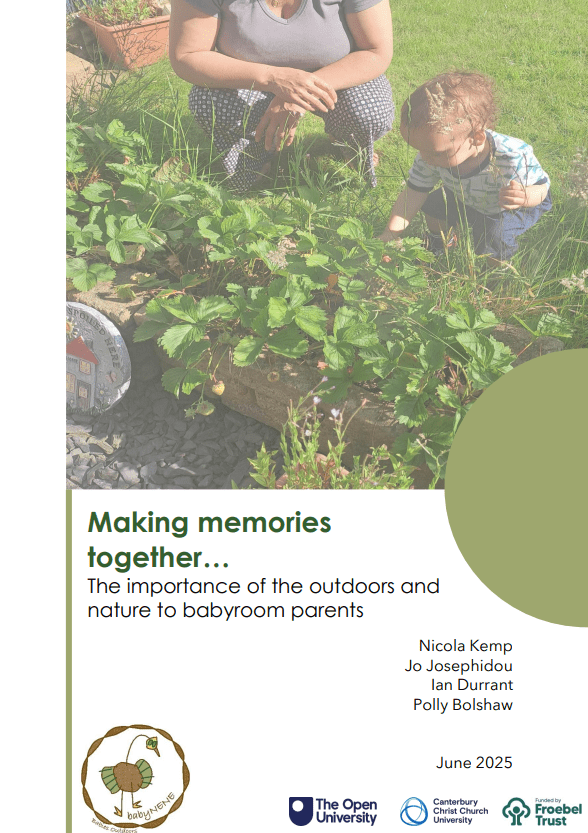
Making memories together… The importance of the outdoors and nature to babyroom parents
In 2024 and 2025 we sent an online survey to all parents of babies and toddlers who attended one UK nursery chain to explore the attitudes and behaviours of babyroom parents to the outdoors and nature. We gathered 233 valid responses from parents across England and Scotland The report considers babies’ access to outdoor spaces at home, what babies do outdoors with their families and parental attitudes and beliefs about spending time with nature. It recognises how understanding the outdoor experiences that babies and toddlers have with their families is a rich starting point for developing more inclusive outdoor pedagogies in ECEC settings.
Kemp, N., Josephidou, J., Durrant, I. and Bolshaw, P. (2025) Making memories together… The importance of the outdoors and nature to babyroom parents. Available at: https://files.froebel.org.uk/production/documents/FT-Making-Memories-Together-Report-June-2025-Kemp-Josephidou.pdf.
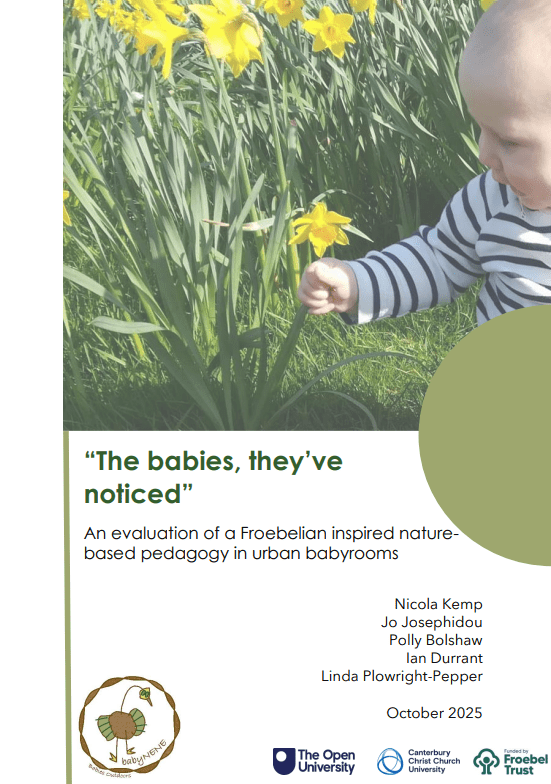
“The babies, they’ve noticed”: an evaluation of a Froebelian inspired nature-based pedagogy in urban babyrooms
In 2025 we evaluated a Froebelian inspired nature-based intervention that took place in five urban babyrooms in London. We had conducted initial baseline visits to the babyrooms in 2024 and then the project team developed a year-long programme of support for the settings in collaboration with Derbyshire Wildlife Trust, which was based on a Froebelian commitment to nature engagement within Early Childhood Education (ECE) settings. We returned to the settings in 2025 to find out what, if anything, had changed in their outdoor provision for babies as a result of the intervention. In this report we provide an overview of the intervention and the resulting changes.
Kemp, N., Josephidou, J., Bolshaw, P., Durrant, I. and Plowright-Pepper, L. (2025) “The babies, they’ve noticed”: An evaluation of a Froebelian inspired nature-based pedagogy in urban babyrooms. Available at: https://files.froebel.org.uk/production/documents/FT-The-Babys-theyve-noticed-Report-Oct-25-Kemp-Josephidou.pdf.
Webinars
Where are the babies? Webinar
In 2021 we took part in a webinar hosted by The Froebel Trust where we shared findings from our first Froebel Trust funded research project, A life ‘in and with nature?’ An exploration of outdoor provision in baby rooms.
The Froebel Trust (2021) Where are the babies? Where are the babies? Exploring outdoor provision for children from birth to two webinar. 29th March. Available at: https://www.youtube.com/watch?v=7Iduj_-2mCY&list=PLiQL7HlObhSj3U79hax0flAe_bw7q_awr.
Blog posts
Layers of exclusion: Developing nature engaging and enhancing pedagogies with infants and toddlers
This blog post considers the findings from our systematic literature review of the research literature focussing on babies and toddlers outdoors and considers how there are multiple layers of exclusion that exclude very young children from the outdoors.
Josephidou, J. (2023) Layers of exclusion: Developing nature engaging and enhancing pedagogies with infants and toddlers. 23 February. Available at: https://www.open.ac.uk/blogs/EarlyChildhood/index.php/2023/02/23/layers-of-exclusion-developing-nature-engaging-and-enhancing-pedagogies-with-infants-and-toddler/.
From Weeds to Tiny Flowers
This blog post gives an overview of our From Weeds to Tiny Flowers report.
Josephidou, J. (2024) From Weeds to Tiny Flowers. 21 February. Available at: https://www.open.ac.uk/blogs/EarlyChildhood/index.php/2024/02/21/from-weeds-to-tiny-flowers/.
Lost words, weeds and tiny flowers.
This blog post also explores some of the thinking linked to our From Weeds to Tiny Flowers report.
Contemplating Childhoods (2024) Lost words, weeds and tiny flowers. 1 March. Available at: https://contemplatingchildhoods.com/2024/03/01/lost-words-weeds-and-tiny-flowers/.
EECERA Conference 2025 – Guest Blog # 31: Where are the babies outdoors?
In this blog post we share how we’ve developed the babyNENE framework to support the development of more inclusive nature-based pedagogies for babies and toddlers.
Josephidou, J., Kemp, N. and Bolshaw, P. (2025) babyNENE: a framework for developing more inclusive nature-based pedagogies for babies. Available at: https://www.eecera.org/general/eecera-conference-2025-guest-blog-31-where-are-the-babies-outdoors/.
Journal articles
Outdoor provision for babies and toddlers: exploring the practice / policy / research nexus in English ECEC settings
This paper offers new knowledge about outdoor provision for under twos in the English context where there is a lack of explicit policy support for outdoor practice. Findings, captured through an online survey from Early Childhood Education and Care (ECEC) settings in one geographically diverse county, reveal a generally positive picture. This suggests that practice is ahead of research. However, the survey also highlights significant variability in outdoor provision. We suggest that, in the absence of a strong policy driver ECEC settings may be inadvertently laying the foundations for inequality of access to the outdoors. Furthermore, a lack of research evidence to inform practice may be contributing to an underdevelopment of the pedagogic value of outdoor environments.
You can read a free Open Access version of the article here.
Josephidou, J., Kemp, N. and Durrant, I. (2021) ‘Outdoor provision for babies and toddlers: exploring the practice/policy/research nexus in English ECEC settings’, European Early Childhood Education Research Journal, 29(6), pp.925-941. DOI: https://doi.org/10.1080/1350293X.2021.1985555.
Babies and toddlers outdoors: a narrative review of the literature on provision for under twos in ECEC settings
This paper reports the findings of a narrative review of international research literature about babies’ and toddlers’ engagement with the outdoor environment whilst attending ECEC (Early Childhood Education and Care) settings. Based on the in-depth review of 21 papers, it identifies four dominant themes in the literature: the outdoors as a space to be physically active, the outdoors as a risky space, the challenge of creating an appropriate outdoor environment and the significance of the practitioner outdoors. The article argues that there is a need to re-conceive the ways in which the youngest children engage with the outdoors and to move beyond possible narratives of exclusion.
You can read free a free Open Access version of the article here.
Kemp, N. and Josephidou, J. (2021) ‘Babies and toddlers outdoors: a narrative review of the literature on provision for under twos in ECEC settings’, Early Years: An International Research Journal, 43(1), pp.137-150. https://doi.org/10.1080/09575146.2021.1915962
A life “in and with nature?” Developing nature engaging and nature enhancing pedagogies for babies and toddlers
This paper explores the contemporary relevance of this thinking to babies and toddlers in early childhood education and care (ECEC) settings. It is based on a research project funded by the Froebel Trust which explores outdoor provision in English settings. Our findings suggest that whilst the pedagogic potential of the outdoors for babies and toddlers appears to be generally recognized, there is little emphasis on supporting them to engage with the natural characteristics of the outdoor environment. Concerns about safety and an emphasis on physical activity mean that natural elements may be discouraged in favour of manufactured alternatives such as artificial grass or commercially produced resources. We argue that Froebelian philosophy offers a much-needed theoretical lens that can illuminate the limitations of such practices for both the human and non-human world. Importantly, we highlight the interconnectedness of human and environmental health and suggest the need to develop nature engaging and nature enhancing pedagogies from birth.
You can read a free Open Access version of the article here.
Josephidou, J. and Kemp. N. (2022) ‘A life “in and with nature?” Developing nature engaging and nature enhancing pedagogies for babies and toddlers’, Global Education Review, 9(2), https://ger.mercy.edu/index.php/ger/article/view/594.
Creating spaces called hope: the critical leadership role of owner/managers in developing outdoor pedagogies for infants and toddlers
There is increasing concern about the ways in which neoliberalism is impacting Early Childhood Education and Care (ECEC), particularly in relation to infants and toddlers. The neoliberal agenda positions the outdoors as risky and a place to be physically active, potentially excluding the youngest children from these spaces. Drawing upon case study data from a larger project exploring outdoor provision for infants and toddlers in England, we demonstrate the critical leadership role owner/managers can play. They do this by creating different kinds of pedagogic spaces (cultural, physical and reflective) for practitioners to develop their outdoor practices. We argue that the creation of such spaces requires explicit acts of resistance and disruption to neoliberal understandings about the place of infants and toddlers outdoors. Our research demonstrates the potential for owner/managers to act as critical pedagogues creating spaces called hope.
You can read a free Open Access version of the article here.
Kemp, N. and Josephidou J. (2023) ‘Creating spaces called hope: the critical leadership role of owner/managers in developing outdoor pedagogies for infants and toddlers’, Early Years: An International Research Journal, 43(3), pp.641-655. https://doi.org/10.1080/09575146.2023.2235913.
Developing nature engaging/nature enhancing pedagogies for babies and toddlers
This article advocates for appropriate nature practices with babies and toddlers and, in particular, Nature Engaging, Nature Enhancing (NENE) pedagogies. The concept of NENE has emerged from research (Josephidou & Kemp, 2022) which focuses on babies’ and toddlers’ opportunities to engage with the outdoors. Our work identifies that there is limited international research in this area and practice can differ widely. We also recognise that only select voices contribute to discussions about what these pedagogies could look like, with Global North narratives dominating. We recognise the problematic nature of this situation from a social justice and babies’ rights perspective but also in the current context of concerns about the climate change crisis and the role of the Early Childhood Education and Care (ECEC) setting in facilitating connections with the natural environment. We suggest that NENE pedagogies not only support children’s holistic development but can also emphasise practices that support planetary health.
This article is free to access online.
Josephidou, J. and Kemp, N. (2021) ‘Developing nature engaging/nature enhancing pedagogies for babies and toddlers’, The First Years: Ngā Tau Tuatahi, 26(1), pp.23-28. Available at: https://www.auckland.ac.nz/assets/education/research/docs/FINAL%20FYJ-Vol26-Iss1-2024.pdf.
‘Tiny humans’ outdoors: understanding the factors that mediate opportunities for babies and toddlers
This paper contributes new knowledge and understanding to an area of international interest in research, policy and practice about the marginalisation of babies and toddlers through its novel outdoor focus. Drawing on a qualitative systematic literature review and adopting a ‘spatialities’ lens, it explores the factors that mediate the experiences of ‘tiny humans’ outdoors. It finds that since their access to, and interactions within, outdoor spaces are dependent upon adults both directly and indirectly, who these adults are (social characteristics) and how they are (cultural values and practices), are critical mediating factors. The outdoors emerges as a socially stratified space in which socio-economic status, class, ethnicity, and (dis)ability intersect in ways that can include or marginalise even from before birth. It is also a cultural space in which values are expressed, transmitted and reproduced through care practices which may (or not) foster a sense of social and spatial inclusion. Finally, the outdoors is a political space in which power relations play out. We argue that, given the rise in babies and toddlers attending ECEC settings globally, these may offer potential sites for developing counter-hegemonic practices that challenge the marginalisation of tiny humans and those that care for them.
You can read a free Open Access version of the article here.
Kemp, N. Josephidou, J. and Bolshaw, P. (2025) ‘Tiny humans’ outdoors: understanding the factors that mediate opportunities for babies and toddlers, Children’s Geographies, 23(2) pp. 219–236. https://doi.org/10.1080/14733285.2025.2479683.
Book chapters
A life ‘in and with’ nature in the period of earliest childhood
This chapter reports on a Froebel Trust funded project entitled ‘A life ‘in and with’ nature in the period of earliest childhood: understanding provision for birth to twos in English babyrooms’. It sought to examine the experiences of babies and toddlers outdoors whilst attending formal day care settings. We will set out some of our findings and thoughts here, drawing particularly on certain Froebelian principles as a lens to consider these findings and their implications. Practices with very young children differ internationally, and even within the UK’s four nations, in terms of when children begin attending Early Childhood Education and Care (ECEC) settings, how long they spend there, how it is funded, and what its purpose is. We discuss here findings from the English context where we carried out our research, but we also draw on international research since this area of focus (i.e., outdoor ECEC practice for children aged from birth to two) is underdeveloped (Bilton, Bento and Dias, 2017).
Josephidou, J. and Kemp, N. (2023) ‘A life ‘in and with’ nature in the period of earliest childhood’ in T. Bruce, Y. Nishida, S. Powell, H. Wasmuth and J. Whinnett (eds.) The Bloomsbury Handbook to Friedrich Froebel. London: Bloomsbury, pp.303-332.
 Babies Outdoors